Anthropic Launches Claude Opus 4.6 Model Days After Software Market Rout

SAN FRANCISCO: Anthropic releases Claude Opus 4.6 model Thursday. The timing comes days after Cowork plugins triggered historic software selloff. New model introduces PowerPoint integration and enhanced reasoning capabilities. AI penetration into knowledge work expands significantly.

The model targets office productivity workflows directly. Native Microsoft PowerPoint support enters research preview. Users can generate presentations while maintaining corporate design templates. Claude parses existing layouts and typography automatically.

Opus 4.6 determines when complex requests require extended reasoning. Simple queries get immediate responses. This addresses key weakness in prior iterations. Anthropic claims model outperforms OpenAI’s GPT-5.2 on knowledge work benchmarks. Finance and legal domains show strongest improvements.

Coding improvements enable task distribution across agent teams. Multiple agents mirror human engineering collaboration patterns. Sequential single-agent execution becomes obsolete. Head of Product Management Dianne Penn frames release as inflection point.

Release arrives amid mounting skepticism regarding AI investment returns. Tuesday saw 6 percent software ETF decline. This marked worst single-day performance since April. Thomson Reuters shares plummeted 15.83 percent Tuesday. LegalZoom dropped nearly 20 percent same session.

Industry-specific Cowork plugins sparked the initial panic. Legal research, financial analysis, sales automation faced existential threats. Marketing analytics and data processing tools also vulnerable. Enhanced capabilities renew concerns about specialized software displacement.

Software sector experienced seventh consecutive day of losses. Multiple Big Tech earnings reports project combined $500 billion capex. Anthropic’s aggressive product velocity positions company at debate center. Question remains whether AI spending represents productivity revolution or speculative bubble.

AWS Posts Fastest Growth in Over Three Years as Cloud, AI Demand Surge

New York: Amazon Web Services (AWS) ended 2025 on a strong note, delivering its fastest quarterly growth rate in more than three years, even as investor concerns weighed on parent company Amazon’s stock.

The cloud business reported $35.6 billion in revenue for the fourth quarter of 2025, up 24% year-on-year, marking its strongest growth in 13 quarters. Amazon said AWS is now operating at an annualised revenue run rate of $142 billion. Operating income for the unit also climbed to $12.5 billion, compared with $10.6 billion in the same quarter last year.

“It’s very different having 24% year-over-year growth on $142 billion annualized run rate than to have a higher percentage growth on a meaningfully smaller base, which is the case with our competitors,” said Andy Jassy during Amazon’s fourth-quarter earnings call. “We continue to add more incremental revenue and capacity than others, and extend our leadership position.”

AWS’s quarterly performance was supported by new deals with companies and government bodies including Salesforce, BlackRock, Perplexity, and the U.S. Air Force.

“More of the top 500 U.S. startups use AWS as their primary cloud provider than the next two providers combined,” Jassy said. “We’re adding significant easy to core computing capacity each day.”

The company added more than one gigawatt of power capacity to its global data centre network during the quarter. Jassy noted that demand continues to come from enterprises migrating from on-premise infrastructure, alongside rising AI workloads.

“We consistently see customers wanting to run their AI workloads where the rest of their applications and data are,” Jassy said. “We’re also seeing that as customers run large AI workloads on AWS, they’re adding to their core AWS footprint as well,” he added.

AWS contributed 16.6% of Amazon’s total $213.4 billion revenue in the quarter. Despite the strong cloud performance, Amazon shares fell 10% in after-hours trading after the company missed earnings expectations and outlined plans to significantly increase capital spending.

OnGrid Buys Reczee to Bring Hiring, Background Checks Under One Roof

Bengaluru: Background verification startup OnGrid has acquired Reczee, an AI-led recruitment platform, to combine hiring and verification into a single, end-to-end workflow. The companies announced the deal on Thursday, though financial terms were not disclosed.

With the acquisition, OnGrid plans to move background verification earlier in the hiring journey, instead of conducting checks only after a job offer is made. The integration is expected to help employers identify risks sooner and improve trust across the recruitment process.

“Recruitment is where trust begins. Joining OnGrid lets us connect AI-driven hiring with what comes next; onboarding, verification, and long-term workforce accountability via eLockr,” said Raj Patel, founder of Reczee.

Reczee provides an AI-powered recruitment system that handles candidate sourcing, screening, coordination and hiring on a single platform.

Founded in 2016, OnGrid works with more than 4,000 organisations across services such as background verification, identity checks, KYC and KYB. The company claims to have processed over one billion verifications and transactions so far.

“We started out as customers of Reczee, using the platform for hiring at OnGrid, and quickly came to love the product. We’re now genuinely excited about the AI capabilities that Reczee brings to the table and believe this combination will unlock meaningful efficiencies and significantly reduce hiring risk for our clients,” said Piyush Peshwani, co-founder of OnGrid.

Reczee will continue operating with its existing product roadmap, while aligning more closely with OnGrid’s broader workforce infrastructure ecosystem.

GitHub Expands Agent HQ With Claude and OpenAI Codex

SAN FRANCISCO: GitHub has officially announced the expansion of its Agent HQ platform by adding Anthropic’s Claude and OpenAI Codex. This move reinforces GitHub’s broader effort to make AI agents a native part of everyday software development.

No additional subscription is required as the integration is available to Copilot Pro+ and Copilot Enterprise customers. Developers can work with multiple AI coding agents directly inside GitHub, GitHub Mobile, and Visual Studio Code.

Developers can start agent sessions and assign work to Claude, Codex, or GitHub Copilot from issues, pull requests, the Agents tab in enabled repositories, and the agent sessions view in VS Code.

Agent HQ supports a multi-agent approach where the same task can be assigned to different agents. This will allow teams to compare how Copilot, Claude, and Codex reason through architectural tradeoffs, edge cases, and implementation strategies.

By keeping agent interactions within existing workflows, developers can move from idea to implementation more easily. They can use different agents for different steps without switching tools or losing context.

Anthropic highlighted the benefit of meeting developers inside their existing collaboration spaces. “We’re bringing Claude into GitHub to meet developers where they are,” said Katelyn Lesse, Head of Platform at Anthropic. “With Agent HQ, Claude can commit code and comment on pull requests, enabling teams to iterate and ship faster and with more confidence.”

OpenAI also emphasized alignment with this vision. Alexander Embiricos from OpenAI added: “We share GitHub’s vision of meeting developers wherever they work, and we’re excited to bring Codex to GitHub and VS Code.”

GitHub confirmed that access to Claude and Codex will expand to additional Copilot subscription tiers. It is also working with Google, Cognition, and xAI to expand the Agent HQ ecosystem across GitHub, VS Code, and the Copilot CLI.

ElevenLabs Raises $500 Million at $11 Billion Valuation

SAN FRANCISCO: Nvidia-backed Voice AI startup ElevenLabs secures $500 million Series D funding at $11 billion valuation, more than tripling its worth from $3.3 billion just one year ago as enterprise adoption accelerates across conversational AI platforms.

Sequoia Capital led the investment, with partner Andrew Reed joining the board to steer global scaling efforts. Power players like Andreessen Horowitz boosted their position fourfold, ICONIQ tripled their commitment, and fresh capital flowed from Lightspeed Venture Partners, Evantic Capital, and BOND – building on Nvidia’s earlier support.

Cumulative funding now stands at $781 million since the 2022 launch. ElevenLabs has advanced from speech-to-text, real-time dubbing, music generation, and intelligent conversational AI agents to Eleven v3 Conversational model. 

The numbers tell a growth story for the ages: ElevenLabs surpassed $330 million in annual recurring revenue (ARR) by late 2025, vaulting from $100 million in under two years. Big-name clients, including Deutsche Telekom, Revolut, Square, and the Ukrainian Government are powering this momentum and merging accessible creator tools with robust enterprise platforms. 

Co-founders Mati Staniszewski and Piotr Dabkowski plan to channel proceeds into “ElevenAgents” and “ElevenCreative,” fusing audio innovation with video and proactive AI capabilities.  

ElevenLabs keeps pushing its global footprint, now spanning key hubs like London, New York, San Francisco, Warsaw, Dublin, Tokyo, Seoul, Singapore, Bengaluru, Sydney, São Paulo, Berlin, Paris, and Mexico City. 

For investors and industry watchers, this positions ElevenLabs as an IPO frontrunner. Amid 2025’s AI funding wave in the U.S. Projections hint at $700 million ARR by mid-2026. Potentially commanding 28x revenue multiples as voice interfaces redefine human-tech interaction. With hubs sprouting in 14 cities, enterprise adoption should accelerate, cementing speech AI’s role in a trillion-dollar agent economy.  

Tech portfolios eyeing the next big shift can’t ignore this voice revolution. 

Mistral AI Releases Voxtral Transcribe 2, Targets Speed and Cost Improvements

Paris: Mistral AI, high-performance AI company introduced Voxtral Transcribe 2, the company’s second-generation speech-to-text models aimed at delivering faster, more accurate, and lower-cost transcription. The release includes two variants, Voxtral Mini Transcribe V2 for batch processing and Voxtral Realtime for live audio applications with latency configurable down to sub-200 milliseconds.

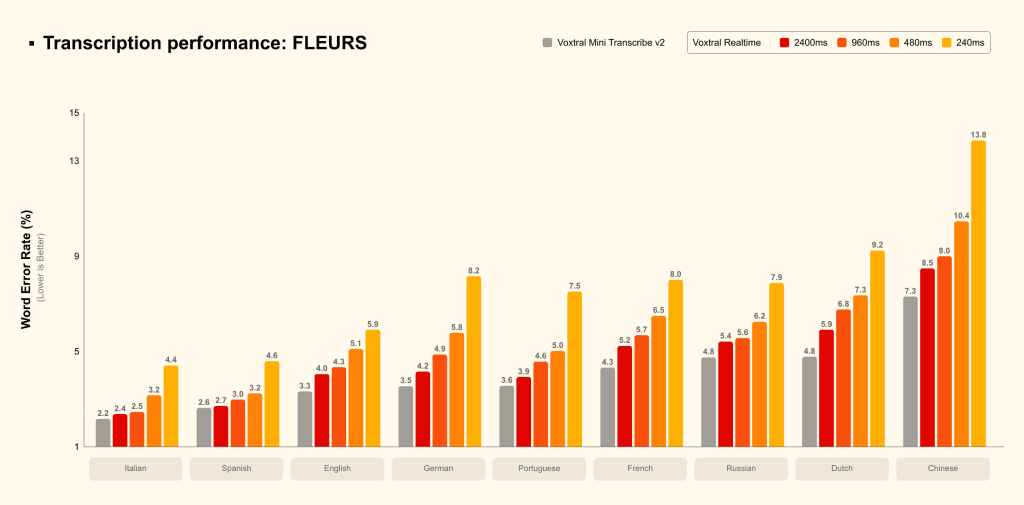
mistral ai error rate
credits: mistral ai

In a post on X, the company described it as “next-gen speech-to-text” offering state-of-the-art transcription, speaker diarization, and sub-200ms real-time latency.

The Paris-based AI firm said the new models are designed to compete directly with leading transcription services while significantly reducing costs. Voxtral Mini Transcribe V2 is priced at $0.003 per minute for batch jobs, which the company says is roughly one-fifth the cost of competing offerings such as ElevenLabs’ Scribe v2.

According to Mistral’s internal benchmarks, the models deliver about a 4%-word error rate on the FLEURS dataset, outperforming several well-known transcription systems while also processing audio up to three times faster than some rivals. The company added that the real-time model can match batch-level accuracy at higher latency settings suitable for live subtitling, while lower latency modes introduce only a small increase in error rates.

Voxtral Mini Transcribe V2 includes features such as speaker diarization, word-level timestamps, and context biasing that allow users to add up to 100 domain-specific terms for improved accuracy. Voxtral Realtime, meanwhile, is built for voice agents, live captioning, and call-center automation.

Notably, Voxtral Realtime is released under the Apache 2.0 license, allowing organizations to deploy it on-premises without relying on external APIs. With a 4-billion-parameter footprint capable of running on edge devices, the models are positioned for industries with strict data-privacy requirements, including healthcare and finance.

Anthropic Promises Claude Will Remain Ad-Free, Launches Super Bowl Campaign

SAN FRANCISCO: AI startup Anthropic has announced that its chatbot, Claude, will remain permanently free from advertising. The pledge was revealed alongside the company’s first-ever Super Bowl advertising campaign, which clearly contrasts its approach with rival OpenAI’s recent move to test sponsored content inside ChatGPT.

Anthropic said conversations with AI assistants are not suitable places for ads. According to the company, users normally talk about personal sensitive matters, software complexities, and thought-provoking issues with Claude. Placing advertisements in such engagement would be clumsy, and the trust would be broken.

To highlight its stance, Anthropic aired a 60-second pregame ad and a 30-second in-game commercial during the Super Bowl. Both carried the tagline, “Ads are coming to AI. But not to Claude.” The ads used satire, showing AI helpers like therapists suddenly interrupting serious conversations to promote products, underscoring how disruptive advertising could feel.

The company claimed that a high percentage of Claude conversations are about issues that individuals would have told their close advisors. Anthropic is certain that advertising during such times will compromise authenticity and user trust.

In response, OpenAI CEO Sam Altman criticized Anthropic’s campaign on X, calling it “clearly dishonest.” He justified the advertising intentions of ChatGPT, claiming that they would be formulated in a very responsible manner that would not affect responses. Altman also mentioned that advertising would make AI available to billions of individuals who would not be able to pay subscriptions.

The ad-free pledge comes as Anthropic demonstrates formidable revenue traction, having crossed $9 billion annual run rate within two years with over 80 percent deriving from enterprise customers through paid subscriptions and business contracts.

The financial momentum underpins Anthropic’s aggressive expansion strategy, with the company simultaneously pursuing massive capital raise that would more than triple its current $11 billion valuation achieved just weeks earlier in ElevenLabs-leading Series D round. Sources familiar with discussions indicate the $350 billion target valuation positions Anthropic among most valuable private AI companies globally.

While acknowledging that ads could be a lucrative option, Anthropic said an ad-based model would create conflicting incentives and go against Claude’s core principle of being genuinely helpful.

The company also stated that in the event that it decides to change the no-ads policy, it would make its intentions clear by stating the reasons why it needs to modify it.

ChatGPT Recovers After Global Outage Affects Thousands

SAN FRANCISCO: OpenAI restores ChatGPT services following a multi-hour global outage that disrupted access for over 12,000 users across web and mobile platforms on February 3.

The disruption began around 3:00 PM Eastern Time, affecting conversations, search functionality, image generation, voice mode and API access as elevated error rates cascaded through OpenAI’s infrastructure. The company acknowledged the incident within minutes and deployed mitigations, marking primary issues resolved by 5:14 PM Eastern.

Down Detector recorded complaints spiking from initial reports at 12:08 PM Pacific to peak levels exceeding 25,000 incidents within two hours. Users encountered error messages preventing them from loading conversations, receiving responses or accessing platform services.

OpenAI’s status page confirmed elevated errors for ChatGPT and Platform users while engineers worked to identify root causes. The timing proved particularly disruptive for professionals and developers relying on ChatGPT for daily workflows, underscoring enterprise dependence on continuous AI availability.

The outage follows OpenAI’s Monday launch of ChatGPT Codex for macOS, which CEO Sam Altman reported achieved over 200,000 first-day downloads. Industry observers speculate unexpectedly high Codex adoption may have contributed to infrastructure strain, though OpenAI has not confirmed specific technical causes.

The incident marks ChatGPT’s latest reliability challenge after previous disruptions in January 2025 and subsequent months. Competitor Anthropic experienced separate Claude outages earlier the same day, suggesting broader infrastructure pressures across AI platforms as user bases scale rapidly and enterprises integrate generative models into critical business operations.

Anthropic’s Launch of New AI Productivity Tools Triggers $285 Billion Software Selloff

SAN FRANCISCO: Anthropic releases legal workflow plugins for its Claude Cowork AI assistant, sparking a $285 billion market capitalization wipeout across software, legal technology and professional services sectors as investors flee companies vulnerable to AI automation.

The legal plugin launched Friday enables Claude to review contracts, flag compliance risks, triage nondisclosure agreements and generate templated legal responses without requiring coding expertise from end users.

RELX and Wolters Kluwer each plunged over 10 percent on Tuesday while Thomson Reuters, LegalZoom and London Stock Exchange Group dropped between 6.5 and 10 percent. A Goldman Sachs basket tracking US software stocks sank 6 percent, its steepest single-day decline since April’s tariff-driven selloff.

The Nasdaq 100 fell as much as 2.4 percent before recovering to close down 1.6 percent. Traders dubbed the panic a SaaSpocalypse, describing sell-at-any-cost behavior as investors reassess AI as replacement rather than complement to existing software platforms.

Anthropic released 11 open-source plugins spanning sales, finance, data analysis, marketing and customer support alongside the legal toolkit. The plugins transform Claude from conversational assistant into specialized domain expert capable of executing multi-step workflows across business functions.

Industry analysts note the legal plugin consists primarily of structured prompts and workflow instructions rather than proprietary fine-tuned models, yet its release crystallizes investor fears around AI agents automating knowledge work previously requiring human specialists.

The broader selloff extends beyond legal software to encompass Indian IT services firms whose full-time-equivalent billing models face existential pressure as AI automates human-led project work traditionally charged by headcount.

Overland AI Secures $100 Mn as Military Demand for Ground Autonomy Rises

SEATTLE: Autonomous ground systems startup Overland AI has raised $100 million in fresh funding as demand grows for its military-grade autonomous vehicles across the US Armed Forces.

The equity round was led by 8VC, with continued backing from Point72 Ventures, Ascend Venture Capital, Shasta Ventures and Overmatch Ventures. New investors include Valor Equity Partners and StepStone Group, while the total raise also features a $20 million venture debt facility from TriplePoint Capital. The funding comes just a year after Overland AI raised $42 million, taking its total capital raised to over $140 million.

Founded in 2022 after spinning out of the University of Washington, Overland AI has grown to more than 100 employees. The company works closely with the U.S. Army, Marine Corps and SOCOM, and recently secured a $2 million contract with the U.S. Army.

Overland AI develops autonomous ground technology that allows a single human operator to control multiple robotic vehicles in complex, off-road and GPS-denied environments. Its systems can be installed on different vehicles and are designed to operate at tactically relevant speeds, including in high-risk combat scenarios such as breaching missions.

The company’s flagship autonomous tactical vehicle, ULTRA, debuted last year and is already being used for autonomous resupply missions following airborne insertions, including deployments with the 82nd Airborne Division.

“Demand for ground autonomy has moved decisively from experimentation to operational integration,” said Stephanie Bonk, co-founder and president of Overland AI. He added, “This funding allows us to scale alongside the units adopting our technology.”

Overland AI completed DARPA’s RACER program last year and has also expanded beyond defense. Recently, it partnered with CAL FIRE to test its autonomous vehicles for wildfire logistics and resupply operations in Southern California.

The startup plans to use the new capital to expand manufacturing, field support and operational integration teams to meet rising military demand.