

NEW YORK: The strategic partnership between Salesforce and OpenAI announced at Dreamforce 2025 represents a fundamental shift in how SaaS platforms must architect their business operations around AI agents, according to analysis from Vivek Sharma, founder of Vyver Consulting Group and the technology executive who coined the term ‘marketecture’.
In commentary shared via social media this week, Sharma stated the Salesforce-OpenAI collaboration ‘marked the beginning of the Agentic Enterprise’ where AI agents stopped being ‘features’ and became the connective tissue between product, data, partnerships, and GTM (go-to-market).”
The October 2025 partnership announcement integrated OpenAI’s GPT-5 frontier models directly into Salesforce’s Agentforce 360 platform, allowing enterprises to access CRM data, query sales records, and build Tableau visualizations through conversational interfaces in ChatGPT. Marc Benioff, Chair and CEO of Salesforce, described the integration as “the trusted foundation for companies to become Agentic Enterprises,” according to the company’s official press release.
Four-Point Framework for Ecosystem Leadership
Sharma, whose nearly two-decade career spans leadership roles at AWS, CA Technologies, Magic Leap, and Vonage before founding Vyver Consulting, outlined four strategic imperatives for SaaS companies to capture ecosystem value in 2026:
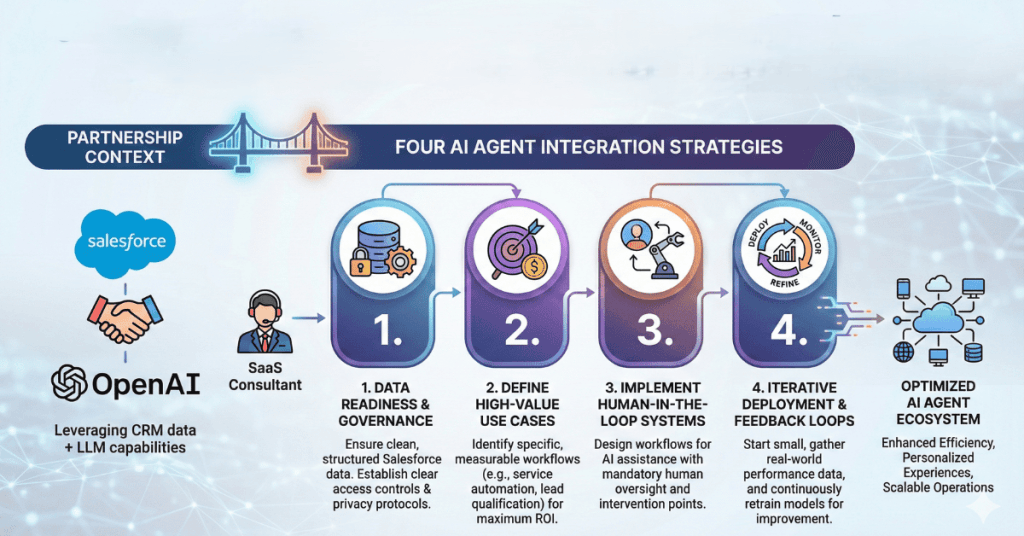
1. Define Your Marketecture: Sharma emphasized that “your product, your partners, and your customer workflows must live in one strategic map,” warning that “no alignment means no ecosystem.” The term “marketecture” – which Sharma coined – refers to the strategic architectural map that connects products, partnerships, and customer value flows into a cohesive visual framework.
Also read: Keyfactor, IBM launch joint post-quantum cryptography solution
2. Choose the Right Partnership Model: The consultant warned that “referral is not enough, resell is not always scalable, and managed service doesn’t fit everyone,” stressing that “your partner model must match what you’re trying to monetize.” This challenges the one-size-fits-all approach many SaaS companies currently employ.
3. Build Enablement and Governance Early: Sharma stated that “roles, KPIs, integration ownership, revenue attribution – all must be clear from day one,” emphasizing that governance frameworks cannot be effectively retrofitted after partnerships are already operational.
4. Treat Partnerships Like Repeatable Systems: The analysis stressed partnerships must be “systems, not launches, not projects,” arguing that “the teams that master repeatability will capture most of the 2026 ecosystem upside.”
The Salesforce-OpenAI Blueprint
The Salesforce-OpenAI integration demonstrates the shift from traditional point-and-click enterprise software to multi-surface, agent-driven conversational platforms. The partnership enables bidirectional operations where users can create leads, update opportunities, and trigger agent workflows directly from ChatGPT conversations while maintaining enterprise security through Salesforce’s Trust Layer.
Sam Altman, Co-founder and CEO of OpenAI, stated the partnership is “about making the tools people use every day work better together, so work feels more natural and connected,” according to Salesforce’s announcement.
The collaboration extends beyond OpenAI to include integrations with Anthropic’s Claude for regulated industries, Google’s Gemini models, and AWS infrastructure, establishing what Salesforce positions as a model-agnostic platform. According to Salesforce’s December 2025 earnings report, Agentforce has become the company’s “fastest growing product ever,” with thousands of customer deployments completed in its first year.
The partnership also introduced the Agentic Commerce Protocol in collaboration with Stripe, enabling merchants to sell directly to ChatGPT’s 800 million weekly users while maintaining control of customer data and relationships.
Market Context and Ecosystem Economics
The global SaaS market, valued at $273.55 billion in 2023, is projected to reach $1,228.87 billion by 2032, creating intense competition among over 30,000 SaaS companies worldwide. Research from Canalys indicates that 70% of SaaS organizations report significant benefits from partnerships, with platform integrations capable of reducing customer acquisition costs by 30% while expanding market reach.
Major SaaS vendors have announced partner-led growth strategies in response to these dynamics. ServiceNow announced plans to add 250,000 new partners and significantly increase partner revenue, while Workday committed to doubling partner capacity by fiscal 2026, according to industry research from Canalys.
The technology consulting market is forecast to surpass $400 billion in 2026 with 7% revenue growth, driven by enterprise demand for expertise in implementing agentic AI systems, according to Source Global Research analysis published in December 2025.

 Previous


