
There is a moment in every technology cycle when the foundations of an industry begin to feel less like bedrock and more like scaffolding. The SaaS industry, valued at over $250 billion globally, may be entering that moment now.
The force behind this shift has an unusual name: Vibe Coding.
Popularized by Andrej Karpathy, vibe coding describes a new paradigm where human intent (your vibe) can be translated directly into functional software by AI systems. What was once a slow, resource-intensive process is becoming nearly instantaneous.
And that changes everything.
For almost over two decades, SaaS thrived on a simple economic truth: building software was expensive, slow, and required specialized talent. Buying software, even if imperfect, was easier.
That asymmetry powered the entire SaaS ecosystem. Today, that advantage is eroding rapidly. Platforms like Replit, Google AI Studio, and emerging tools such as Lovable, cursor and emergent are compressing the cost and time of software creation to near zero.
AI has effectively removed execution as the bottleneck. What remains is imagination.
Why Rent When You Can Own it?
Going by the widely considered concept that becoming an owner is always better than hiring something on rent. The implications, meanwhile, go far beyond productivity gains.
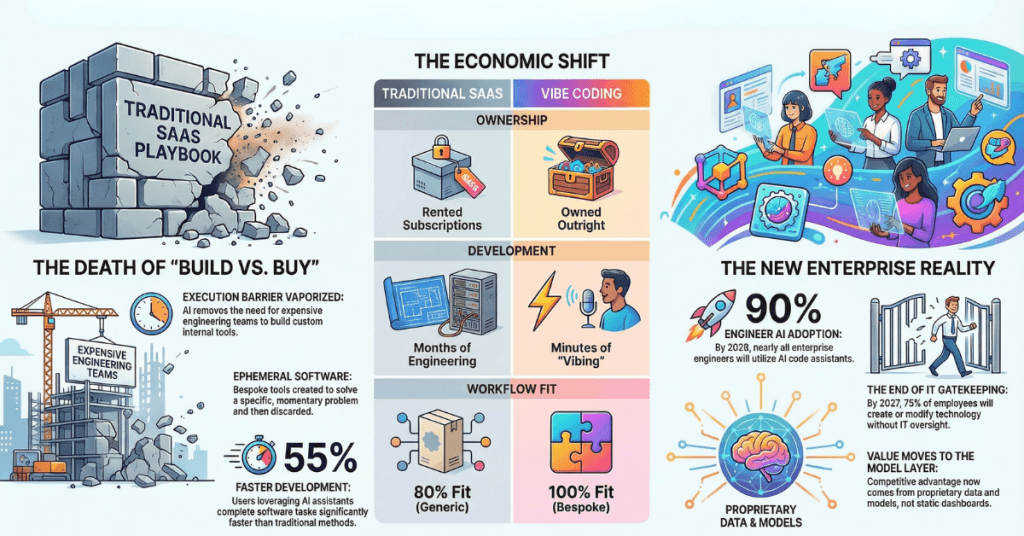
Traditional SaaS operates on a compromise. Businesses adopt tools that solve 70-80% of their needs and adjust their workflows around the remaining gaps. This ‘good enough’ model created a massive market.
But in a world where software can be generated on demand, that compromise starts to look unnecessary. Instead of renting generic tools, organizations can now build custom internal software tailored to their exact workflows, iterate in real time without waiting for vendor roadmaps and own and control their tools entirely.
This shift is already reflected in data.
According to Gartner, by 2028, 90% of enterprise developers will use AI coding assistants, up from just 14% in early 2024. Meanwhile, 75% of employees are expected to build or modify software themselves by 2027, signaling a move away from centralized IT control. This overall shift raises the question of paying for something generic.
A Growing Risk No One in SaaS Can Ignore
Saying that not all SaaS companies are equally vulnerable, enterprise giants like Salesforce, Workday, and ServiceNow benefit from deep integrations, proprietary datasets, and entrenched network effects. These are not easily replaced overnight.
But the long tail of SaaS: tools like niche workflow automation platforms, internal dashboards and lightweight project management tools, faces a different reality.
When a founder or operator can describe a requirement to an AI agent and receive a working tool within hours, the economic argument for subscription-based alternatives weakens dramatically.
Understanding Ephemeral Software
Another emerging concept is ‘ephemeral software’, tools built for a specific task, used briefly, and then discarded or regenerated. This is a stark departure from traditional SaaS, where tools are Persistent, Standardized and Designed for mass adoption. In contrast, AI-generated tools are Temporary, Highly personalized and Continuously evolving.
It’s software not as a product, but as a process.
Where the Value Shifts Next
If application-layer software becomes abundant, where does value move? The answer appears to lie in Models (AI capabilities themselves), Data (proprietary and contextual intelligence) and Platforms (environments where software is generated and deployed).
According to a report, the AI software platforms market is expected to reach $153 billion by 2028, growing at over 40% CAGR. Meanwhile, traditional SaaS spending continues to rise. For an instance, Zylo reports 9.3% year-over-year growth, driven partly by AI-related price increases.
Ironically, businesses are paying more for software at the very moment alternatives are becoming cheaper.
From Tools to Outcomes
For SaaS companies, this shift doesn’t necessarily signal extinction, but it does demand reinvention. It is just like the evolution of AI. When it was considered that AI will be a threat to people, it is actually helping them in becoming more productive in the given time.
Similarly, the next generation of successful companies will likely move up the value chain, from tools to outcomes, focus on intelligence, not interfaces and build deep relationships and ecosystems, not just products.
Because in a world where anyone can generate software, the software itself is no longer the moat.
This is an editorial piece and reflects the views of the Tea4Tech editorial team.

 Previous


