
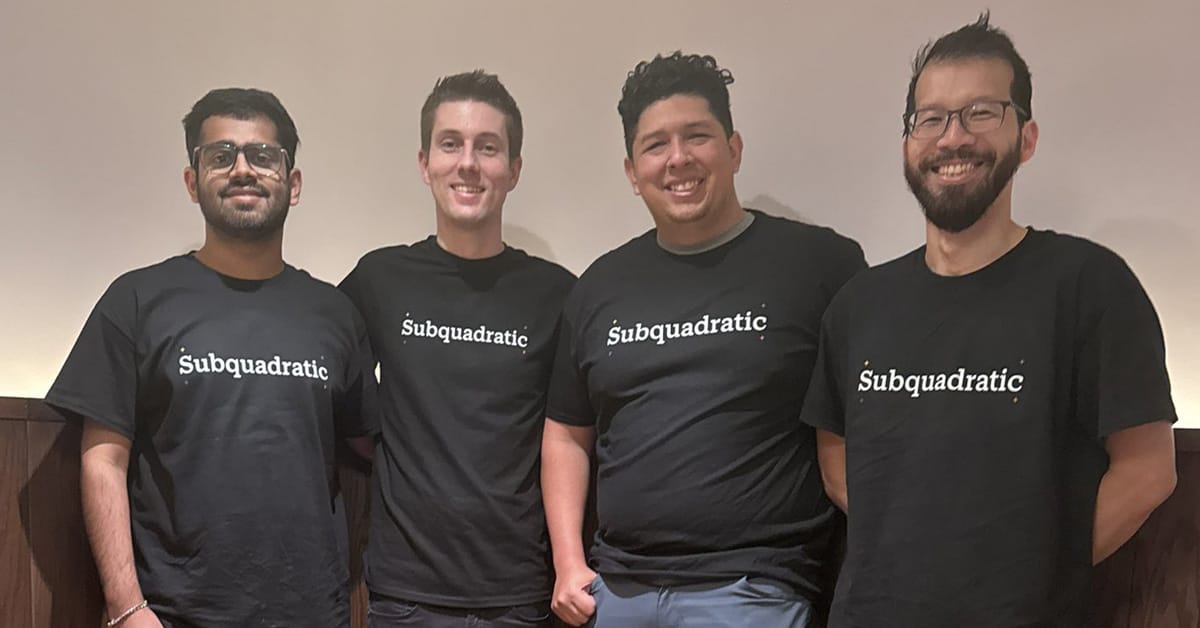
MIAMI: The Miami-based startup Subquadratic has successfully bagged $29 million in seed funding and bold claims about transforming AI efficiency.
The company launches SubQ, its first large language model. The model is reportedly known for reducing attention compute by nearly 1,000 times at 12 million tokens. SubQ supports a native 12 million-token context window in research configurations.
The architecture relies on Subquadratic Sparse Attention, or SSA. Standard transformer attention scales quadratically with input length, driving costs higher exponentially. SSA scales linearly instead, fundamentally changing the economics of long-context AI.
Subquadratic claims SubQ runs 52 times faster than FlashAttention at one million tokens. The model also costs roughly one-fifth of frontier alternatives like Claude Opus. Benchmark scores show 81.8% on SWE-Bench Verified, comparable to leading models.
Backers include former SoftBank Vision Fund partner Javier Villamizar. Tinder co-founder Justin Mateen also participates in the seed round. The investor mix reflects both AI specialists and consumer technology veterans.
The company launches three products into private beta alongside the announcement. SubQ Code provides a command-line coding agent for developers. SubQ Search offers retrieval capabilities, while an API exposes the full context window.
“Efficiency is the next frontier in AI, not just raw model size,” says co-founder Justin Dangel.
Skeptics demand independent verification of the dramatic efficiency claims. Some developers describe the published benchmarks as suspiciously favorable to Subquadratic. Researchers note that extraordinary results require external validation before broad acceptance.
If validated, the architecture could reshape AI economics significantly. Long-context applications currently cost thousands of dollars per query at scale. Subquadratic claims comparable workloads run for under $10 on SubQ.
The company plans broader access following its current early-access program rollout.

 Previous


